publications
My main research publications. For a complete list you can check my Google Scholar.
2026
-
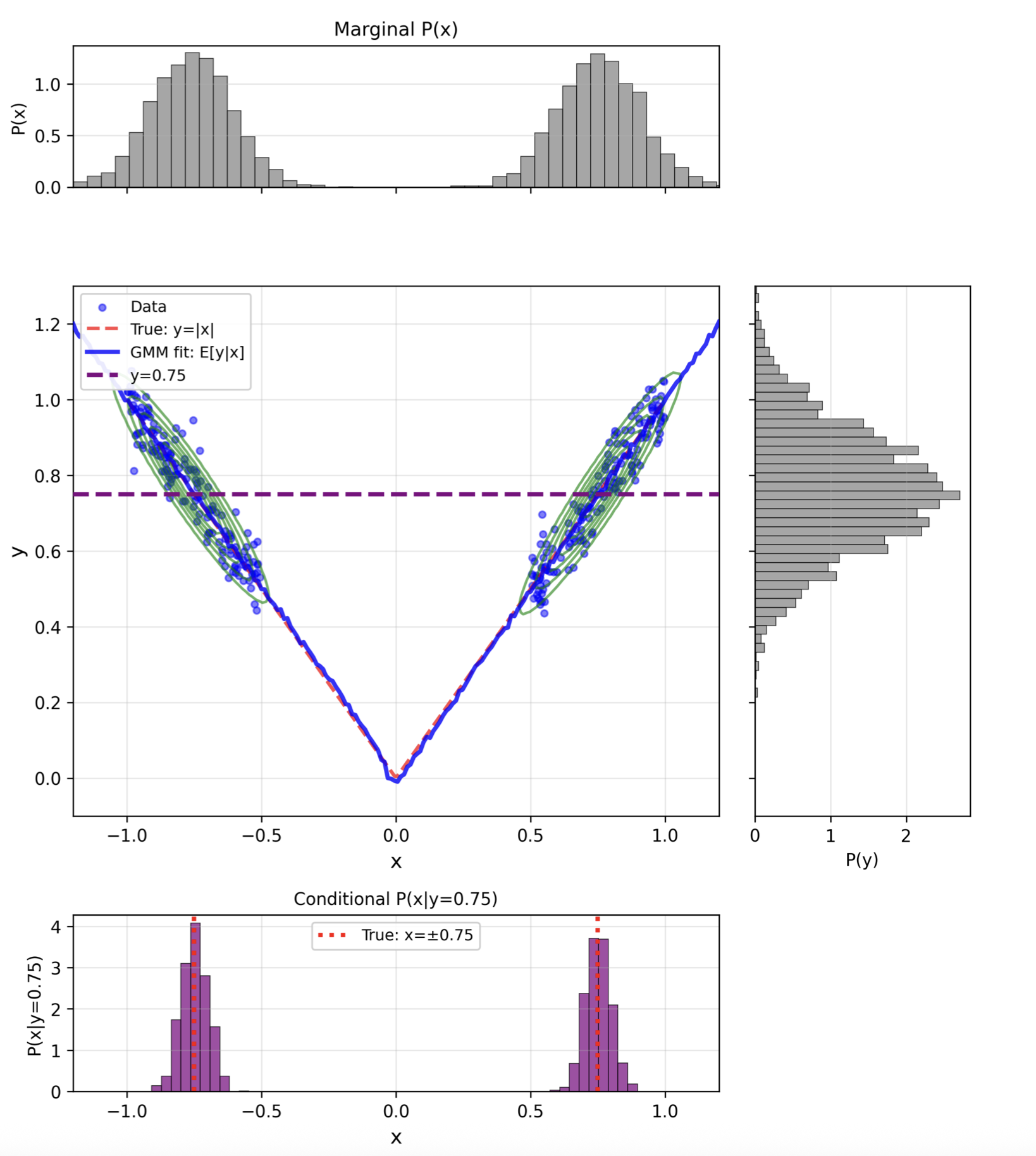 Generative machine learning approaches to optimizationVictor Alves, and John KitchinChemRxiv, 2026
We present a generative machine learning approach to optimization problems. The key idea is that generative models can learn the joint probability distribution of variables and their derivatives, or transform simple distributions to target distributions. By conditioning on desired properties (e.g., derivatives equal to zero), solutions are obtained by sampling. We demonstrate this using Gaussian mixture models, which approximate joint distributions, and conditional flow matching, which learns distribution transformations. Examples include root finding, unconstrained and constrained optimization, parameter estimation, and state space mapping. This pedagogical work shows that generative models offer a fundamentally different approach to optimization, one that is data-driven, does not require iterative solvers, and naturally handles problems with multiple solutions by representing the full solution distribution. We discuss limitations and conclude the approach shows promise as an alternative to conventional methods.
@article{alves_generative_2025, author = {Alves, Victor and Kitchin, John}, title = {Generative machine learning approaches to optimization}, journal = {ChemRxiv}, volume = {2026}, number = {0127}, pages = {}, year = {2026}, doi = {10.26434/chemrxiv-2025-hk886/v3}, } -
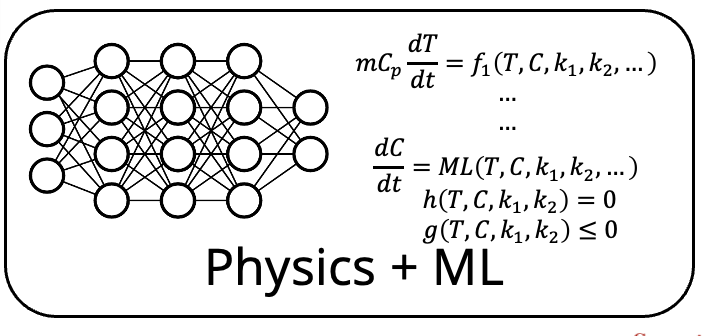 A Simultaneous Approach for Training Neural Differential-Algebraic Systems of EquationsLaurens R. Lueg, Victor Alves, Daniel Schicksnus, John R. Kitchin, and 2 more authors2026
Scientific machine learning is an emerging field that broadly describes the combination of scientific computing and machine learning to address challenges in science and engineering. Within the context of differential equations, this has produced highly influential methods, such as neural ordinary differential equations (NODEs). Recent works extend this line of research to consider neural differential-algebraic systems of equations (DAEs), where some unknown relationships within the DAE are learned from data. Training neural DAEs, similarly to neural ODEs, is computationally expensive, as it requires the solution of a DAE for every parameter update. Further, the rigorous consideration of algebraic constraints is difficult within common deep learning training algorithms such as stochastic gradient descent. In this work, we apply the simultaneous approach to neural DAE problems, resulting in a fully discretized nonlinear optimization problem, which is solved to local optimality and simultaneously obtains the neural network parameters and the solution to the corresponding DAE. We extend recent work demonstrating the simultaneous approach for neural ODEs, by presenting a general framework to solve neural DAEs, with explicit consideration of hybrid models, where some components of the DAE are known, e.g. physics-informed constraints. Furthermore, we present a general strategy for improving the performance and convergence of the nonlinear programming solver, based on solving an auxiliary problem for initialization and approximating Hessian terms. We achieve promising results in terms of accuracy, model generalizability and computational cost, across different problem settings such as sparse data, unobserved states and multiple trajectories. Lastly, we provide several promising future directions to improve the scalability and robustness of our approach.
@misc{lueg_simultaneous_2025, title = {A Simultaneous Approach for Training Neural Differential-Algebraic Systems of Equations}, author = {Lueg, Laurens R. and Alves, Victor and Schicksnus, Daniel and Kitchin, John R. and Laird, Carl D. and Biegler, Lorenz T.}, year = {2026}, eprint = {2504.04665}, archiveprefix = {arXiv}, primaryclass = {cs.LG}, doi = {10.48550/arXiv.2504.04665} } -
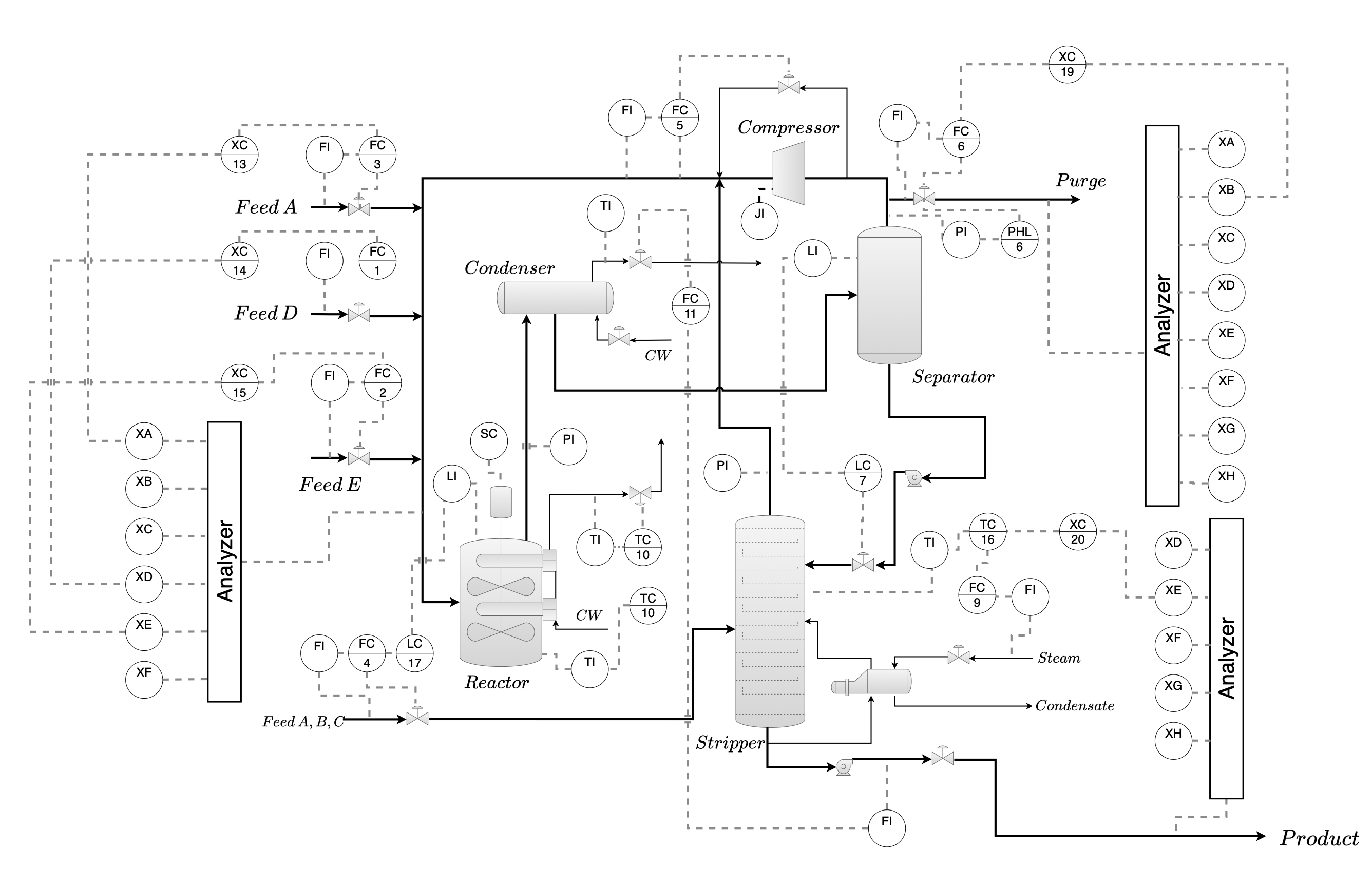 Benchmarking Machine Learning Fault Detection Methods on the Tennessee Eastman Process DatasetNaixin Lyu, Suraj Botcha, Eesha Kulkarni, Shreya Pagaria, and 3 more authorsChemRxiv, 2026
The Tennessee Eastman Process (TEP) dataset is a standard benchmark for process control and fault diagnosis due to its complex, multivariate dynamics. We evaluate a broad range of machine learning and deep learning methods for multivariate time-series anomaly detection on the dataset, covering 17 of its 20 fault types. After preprocessing the dataset, we benchmark classical models such as XGBoost and sequence models including LSTM classifiers, LSTM-FCN, a convolutional transformer, and a proposed Transformer-Kalman (TransKal) classifier. We also assess hybrid LSTM and convolutional autoencoder approaches. Supervised models were trained on combined normal and faulty data, while semi-supervised models used only normal data. Finally, we evaluate the models using an independent dataset to assess generalizability. Several models achieved 99%+ multiclass accuracy, but showed fragility on the independent dataset.
@article{alves_tep2026,
  author = {Lyu, Naixin and Botcha, Suraj and Kulkarni, Eesha and Pagaria, Shreya and Alves, Victor and Sunshine, Ethan M and Kitchin, John R},
  title = {Benchmarking Machine Learning Fault Detection Methods on the Tennessee Eastman Process Dataset},
  journal = {ChemRxiv},
  volume = {2026},
  number = {0127},
  pages = {},
  year = {2026},
  doi = {10.26434/chemrxiv.10001628/v1},
}
2025
-
 Beyond the fourth paradigm of modeling in chemical engineeringJohn R. Kitchin, Victor Alves, and Carl D. LairdNature Chemical Engineering, 2025
Differentiable programming underpins the foundations of machine learning, and enables new approaches to solving chemical engineering problems. This Comment discusses the opportunities and challenges in education and preparing the workforce to leverage these tools. Integration of these skills with domain knowledge can have a substantial impact on the future of chemical engineering.
@article{kitchin_beyond_2025, title = {Beyond the fourth paradigm of modeling in chemical engineering}, issn = {2948-1198}, journal = {Nature Chemical Engineering}, author = {Kitchin, John R. and Alves, Victor and Laird, Carl D.}, date = {2025}, year = {2025}, doi = {10.1038/s44286-024-00170-x}, } -
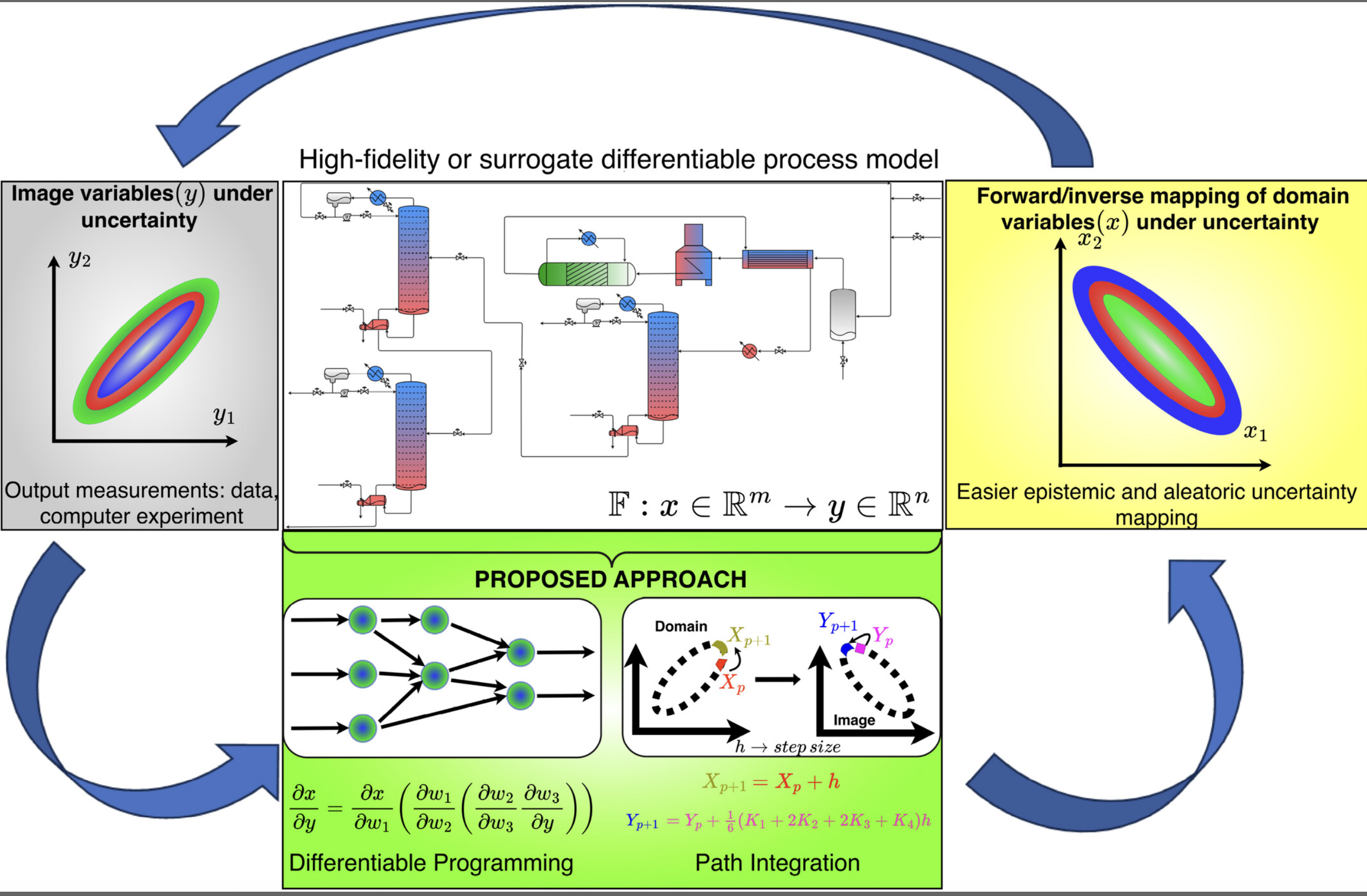 Mapping uncertainty using differentiable programmingVictor Alves, Carl D. Laird, Fernando V. Lima, and John R. KitchinAIChE Journal, 2025
Uncertainty quantification (UQ) and propagation is a ubiquitous challenge in science, permeating our field in a general fashion, and its importance cannot be overstated. Recently, the commoditization of differentiable programming, motivated by the development of machine learning, has allowed easier access to tools for evaluating derivatives of complex systems, of implicit and nonlinear nature. Motivated by this, we develop a UQ mapping approach based on differentiable programming principles. The approach is novel, faster, and yields equally accurate results when compared against the current state-of-the-art approaches for the UQ problem, which is to quantify and map uncertainty using linear methods or expensive Monte Carlo simulations. Three case studies—namely a continuous stirred tank reactor, a membrane reactor, and a fed-batch bioreactor—are assessed and compared against typical uncertainty mapping techniques. Lastly, the method allows the use of a single model implementation to perform forward and inverse uncertainty maps, easily switching mapping directions.
@article{alves2025_b,
  author = {Alves, Victor and Laird, Carl D. and Lima, Fernando V. and Kitchin, John R.},
  title = {Mapping uncertainty using differentiable programming},
  journal = {AIChE Journal},
  volume = {71},
  number = {10},
  pages = {e18940},
  keywords = {automatic differentiation, forward mapping, inverse mapping, inverse problems, uncertainty quantification},
  year = {2025},
  doi = {10.1002/aic.18940},
}
2024
-
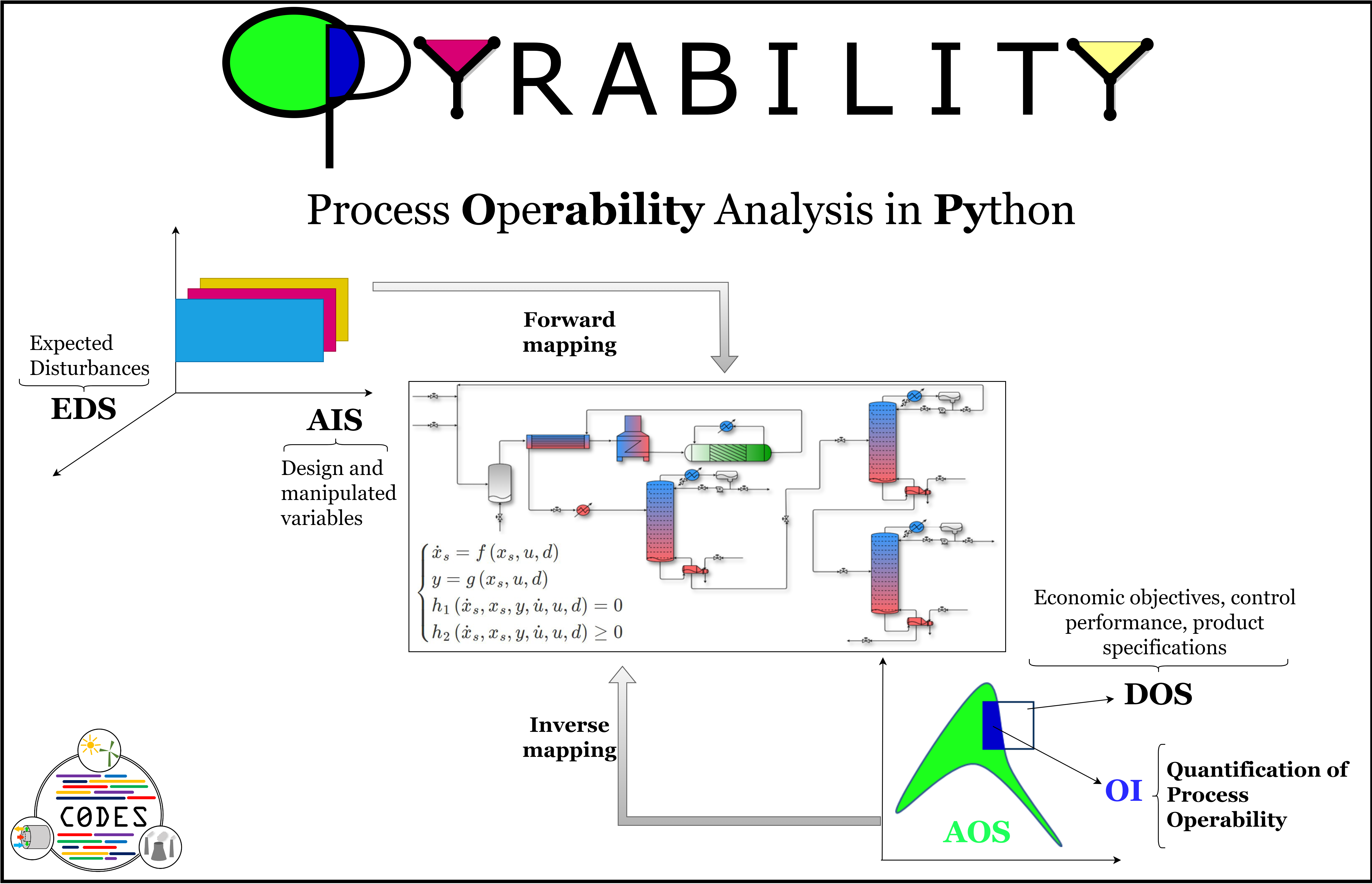 Opyrability: A Python package for process operability analysisVictor Alves, San Dinh, John R. Kitchin, Vitor Gazzaneo, and 2 more authorsJournal of Open Source Software, 2024
Opyrability corresponds to a unified software tool to perform process operability analysis in a single-bundle fashion. In broader terms, opyrability provides a formal and mathematically tractable framework to systematically investigate the operability and achievability of industrial processes earlier in the conceptual phase. This eliminates the need for resorting to ad-hoc-type solutions to the design and control of industrial processes, which are inherently with loss of generality. The use of this framework thus guarantees a solution to the operability problem that is generalizable to any process, as long as a mathematical model of the given application is available. Hence, the introduction of opyrability in Python, a widely used and freely available programming language, is a significant advancement in the process operability field. Being open-source and hosted in a community-driven environment, it offers a valuable resource to the process systems engineering, computational catalysis and material sciences communities that would benefit from operability direct/inverse mappings. This package empowers researchers and practitioners to easily investigate the operability aspects of both emerging and existing large-scale industrial processes. Additionally, on a lab scale, it can aid in the examination of material properties that guide design decisions, such as reactions rate and membrane parameters that would be needed to reach certain product specifications.
@article{alves2024, doi = {10.21105/joss.05966}, year = {2024}, publisher = {The Open Journal}, volume = {9}, number = {94}, pages = {5966}, author = {Alves, Victor and Dinh, San and Kitchin, John R. and Gazzaneo, Vitor and Carrasco, Juan C. and Lima, Fernando V.}, title = {Opyrability: A Python package for process operability analysis}, journal = {Journal of Open Source Software}, } -
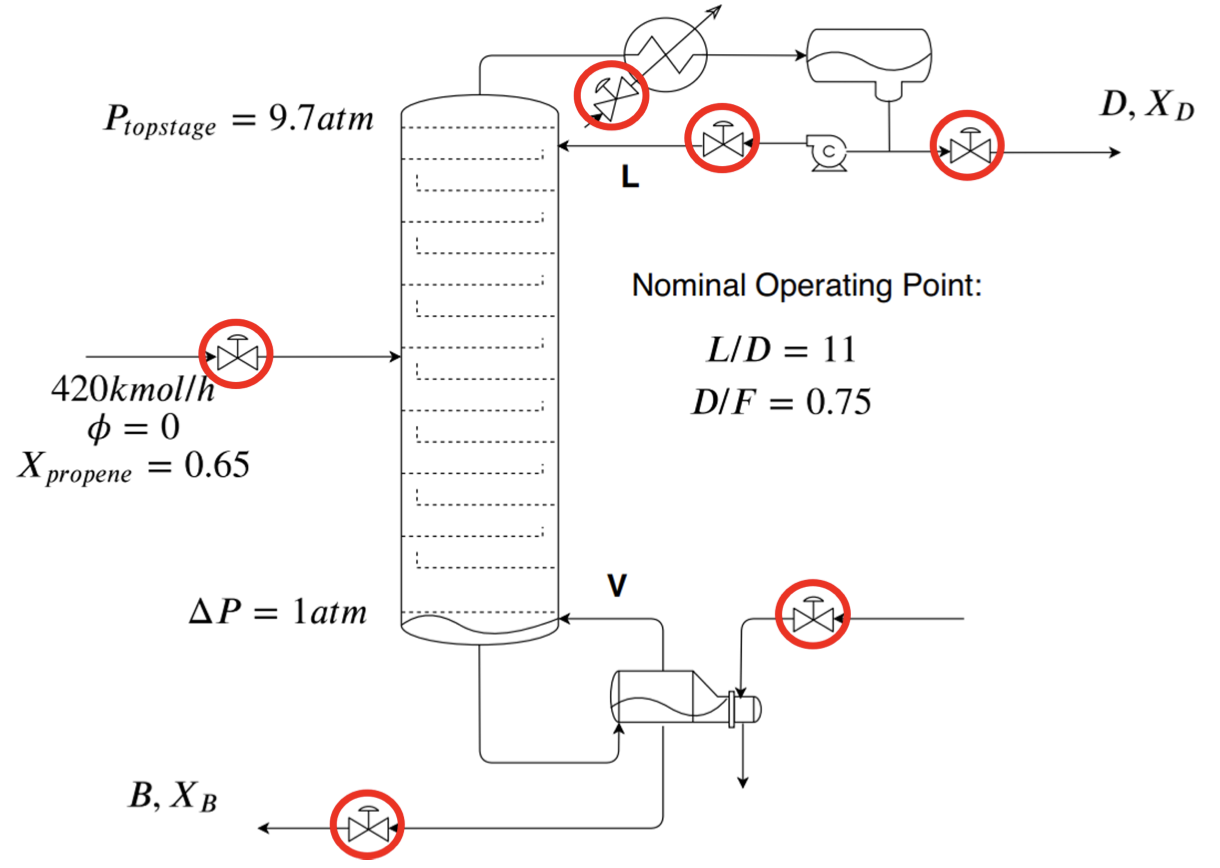 On the selection of control structures using process operability analysisVictor Alves, and Fernando V. LimaControl Engineering Practice, 2024
This work aims to develop a generalizable framework for control structure selection using process operability analysis. Current approaches for selecting controlled variables in chemical processes are limited to assessing system attributes individually, focusing on controller performance or the economic impact based on a constant setpoint policy. However, the competitive industrial manufacturing market requires a holistic approach for control structure selection in large-scale plants that takes into account multiple factors. In particular, process operability can help to enable a generalizable approach that is able to select control structures that are operable considering economic and performance factors simultaneously. To achieve this goal, a framework that uses the Operability Index (OI) as a metric for ranking the achievability of the control objectives for the selected control structures is developed. To test the framework, a depropanizer distillation column is investigated as a case study associated with large-scale energy systems. This work thus introduces novel formulations and algorithms for the control structure selection problem, enhancing the design, operations, and synthesis of existing and future industrial systems.
@article{alves2024b,
  title = {On the selection of control structures using process operability analysis},
  journal = {Control Engineering Practice},
  volume = {153},
  pages = {106117},
  year = {2024},
  issn = {0967-0661},
  doi = {10.1016/j.conengprac.2024.106117},
  url = {https://www.sciencedirect.com/science/article/pii/S0967066124002764},
  author = {Alves, Victor and Lima, Fernando V.},
  keywords = {Process operability, Plantwide control, Control structure selection, Control design, Process control},
}
2023
-
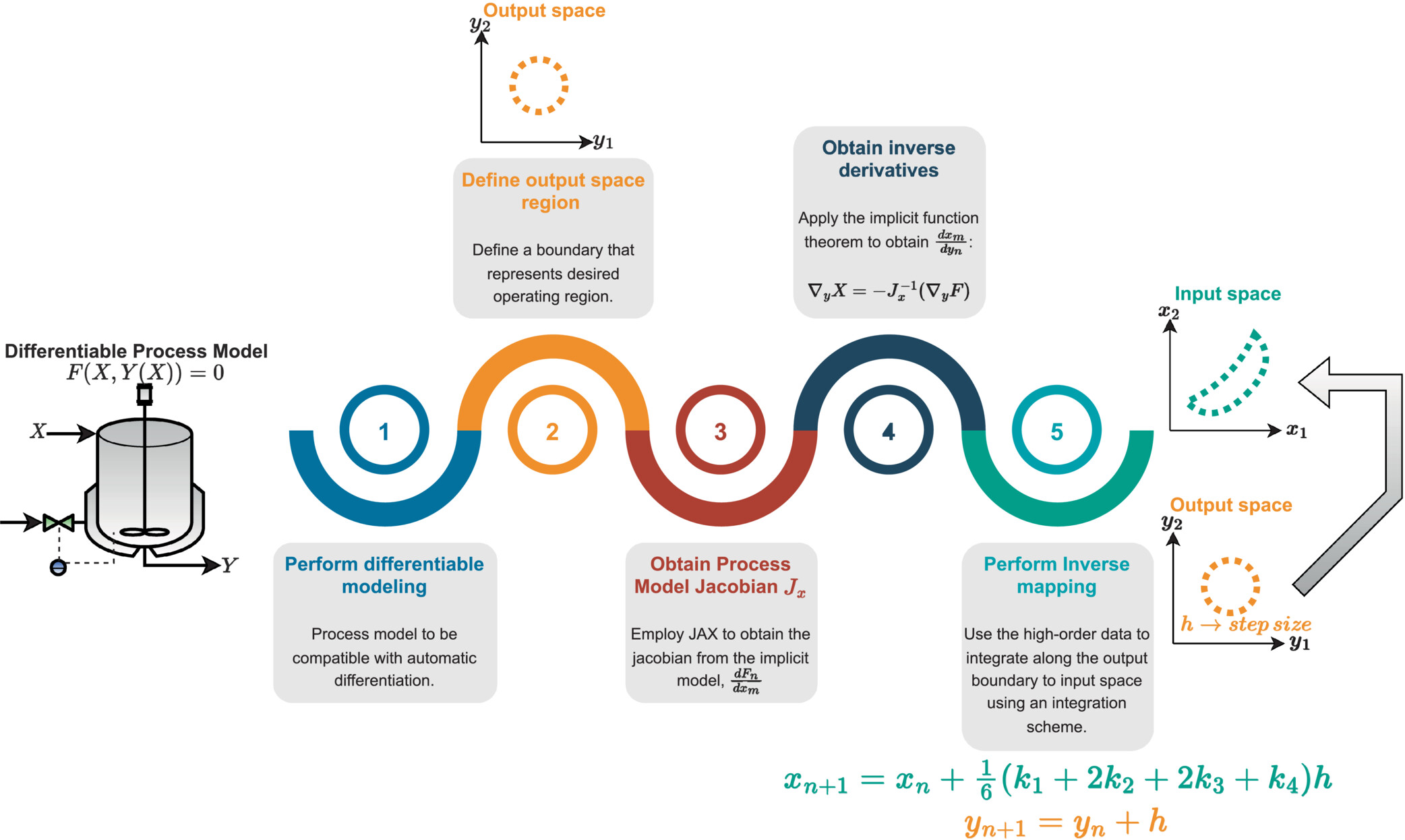 An inverse mapping approach for process systems engineering using automatic differentiation and the implicit function theoremVictor Alves, John R Kitchin, and Fernando V LimaAIChE Journal, 2023
The objective in this work is to propose a novel approach for solving inverse problems from the output space to the input space using automatic differentiation coupled with the implicit function theorem and a path integration scheme. A common way of solving inverse problems in process systems engineering (PSE) and in science, technology, engineering and mathematics (STEM) in general is using nonlinear programming (NLP) tools, which may become computationally expensive when both the underlying process model complexity and dimensionality increase. The proposed approach takes advantage of recent advances in robust automatic differentiation packages to calculate the input space region by integration of governing differential equations of a given process. Such calculations are performed based on an initial starting point from the output space and are capable of maintaining accuracy and reducing computational time when compared to using NLP-based approaches to obtain the inverse mapping. Two nonlinear case studies, namely a continuous stirred tank reactor (CSTR) and a membrane reactor for conversion of natural gas to value-added chemicals are addressed using the proposed approach and compared against: (i) extensive (brute-force) search for forward mapping and (ii) using NLP solvers for obtaining the inverse mapping. The obtained results show that the novel approach is in agreement with the typical approaches, while computational time and complexity are considerably reduced, indicating that a new direction for solving inverse problems is developed in this work.
@article{alves2023inverse, title = {An inverse mapping approach for process systems engineering using automatic differentiation and the implicit function theorem}, author = {Alves, Victor and Kitchin, John R and Lima, Fernando V}, journal = {AIChE Journal}, pages = {e18119}, year = {2023}, publisher = {John Wiley \& Sons, Inc. Hoboken, USA}, video = {https://www.youtube.com/live/UAIUSr4TzBk?feature=share}, doi = {10.1002/aic.18119} } -
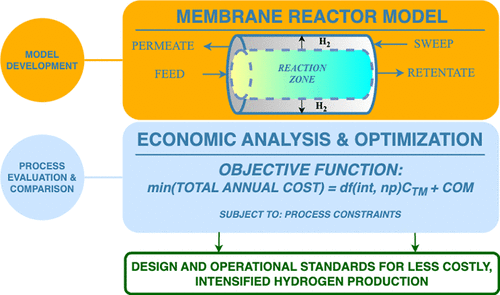 Techno-economic Analysis and Optimization of Intensified, Large-Scale Hydrogen Production with Membrane ReactorsDean M. Sweeney, Victor Alves, Savannah Sakhai, San Dinh, and 1 more authorIndustrial & Engineering Chemistry Research, 2023
Steam methane reforming (SMR) currently supplies 76% of the world’s hydrogen (H2) demand, totaling ∼70 million tonnes per year. Developments in H2 production technologies are required to meet the rising demand for cleaner, less costly H2. Therefore, palladium membrane reactors (Pd-MR) have received significant attention for their ability to increase the efficiency of traditional SMR. This study performs novel economic analyses and constrained, nonlinear optimizations on an intensified SMR process with a Pd-MR. The optimization extends beyond the membrane’s operation to present process set points for both the conventional and intensified H2 processes. Despite increased compressor and membrane capital costs along with electric utility costs, the SMR-MR design offers reductions in the natural gas usage and annual costs. Economic comparisons between each plant show Pd membrane costs greater than $25 000/m2 are required to break even with the conventional design for membrane lifetimes of 1–3 years. Based on the optimized SMR-MR process, this study concludes with sensitivity analyses on the design, operational, and cost parameters for the intensified SMR-MR process. Overall, with further developments of Pd membranes for increased stability and lifetime, the proposed SMR-MR design is thus profitable and suitable for intensification of H2 production.
@article{sweeney23,
  author = {Sweeney, Dean M. and Alves, Victor and Sakhai, Savannah and Dinh, San and Lima, Fernando V.},
  title = {Techno-economic Analysis and Optimization of Intensified, Large-Scale Hydrogen Production with Membrane Reactors},
  journal = {Industrial \& Engineering Chemistry Research},
  volume = {62},
  number = {46},
  pages = {19740-19751},
  year = {2023},
  doi = {10.1021/acs.iecr.3c02045},
  eprint = {10.1021/acs.iecr.3c02045},
}
2022
-
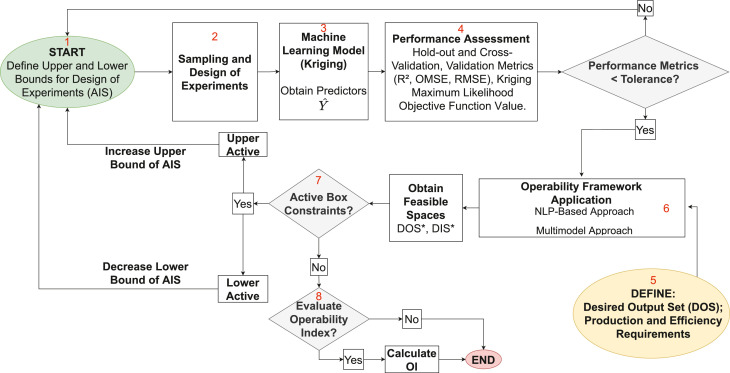 A machine learning-based process operability framework using Gaussian processesVictor Alves, Vitor Gazzaneo, and Fernando V LimaComputers & Chemical Engineering, 2022
The objective in this work is to develop a machine learning-based framework for process operability using surrogate responses based on Kriging (also known as Gaussian Process Regression). Currently, the available operability approaches for nonlinear systems are limited by the problem dimensionality that they can address, not being computationally tractable for high-dimensional systems. The proposed approach will use Kriging-based models to substitute the developed first-principles or process simulation-based models. The built surrogate models can generate responses that are comparable to the first-principles nonlinear models in terms of accuracy, while reducing the computational effort. To achieve this goal, a framework for the systematic analysis of highly nonlinear, large-dimensional systems at steady state is developed. The proposed approach is benchmarked against current operability methods and provides a new direction in the process operability field employing Kriging models. Two case studies associated with natural/shale gas conversion are addressed to illustrate the effectiveness of the proposed methods, namely a membrane reactor for direct methane conversion to fuels and chemicals and a natural gas combined cycle power plant. It is shown that the computational time for operability calculations is significantly decreased when using the developed approach, with reductions of up to four orders of magnitude, while the relative errors with respect to the output responses is below 0.3% for the worst-case scenario considering all cases. This work thus contributes to machine learning formulations and algorithms for process operability to enable the improved design, operations and manufacturing of chemical and energy systems.
@article{alves2022machine,
  title = {A machine learning-based process operability framework using Gaussian processes},
  author = {Alves, Victor and Gazzaneo, Vitor and Lima, Fernando V},
  journal = {Computers \& Chemical Engineering},
  volume = {163},
  pages = {107835},
  year = {2022},
  publisher = {Elsevier},
  doi = {10.1016/j.compchemeng.2022.107835},
}
2020
-
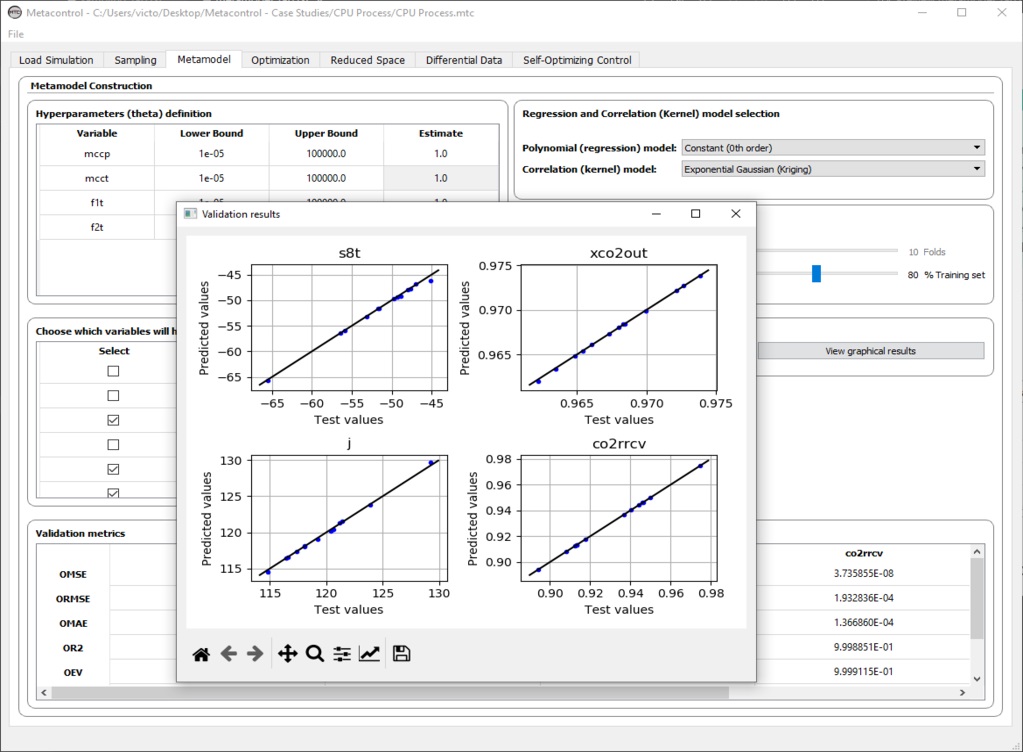 Metacontrol: A Python based application for self-optimizing control using metamodelsFelipe Souza Lima, Victor Manuel Cunha Alves, and Antonio Carlos Brandao AraujoComputers & Chemical Engineering, 2020
In this contribution, a detailed description of a Python based application tool that enables fast implementation of the Self-Optimizing Control (SOC) technology with the help of surrogate models is presented. The paper also outlines the potential uses of the Metacontrol (from Metamodel-based self-optimizing control) software through case studies of representative test-bed industrial processes. As a result, an in-depth analysis of Metacontrol from a plantwide control perspective is discussed, together with recommendations for use. The data, examples, and the Metacontrol source code are available for download at https://github.com/feslima/metacontrol.
@article{lima2020metacontrol,
  title = {Metacontrol: A Python based application for self-optimizing control using metamodels},
  author = {Lima, Felipe Souza and Alves, Victor Manuel Cunha and Araujo, Antonio Carlos Brandao},
  journal = {Computers \& Chemical Engineering},
  volume = {140},
  pages = {106979},
  year = {2020},
  publisher = {Elsevier},
  doi = {10.1016/j.compchemeng.2020.106979},
}
2018
-
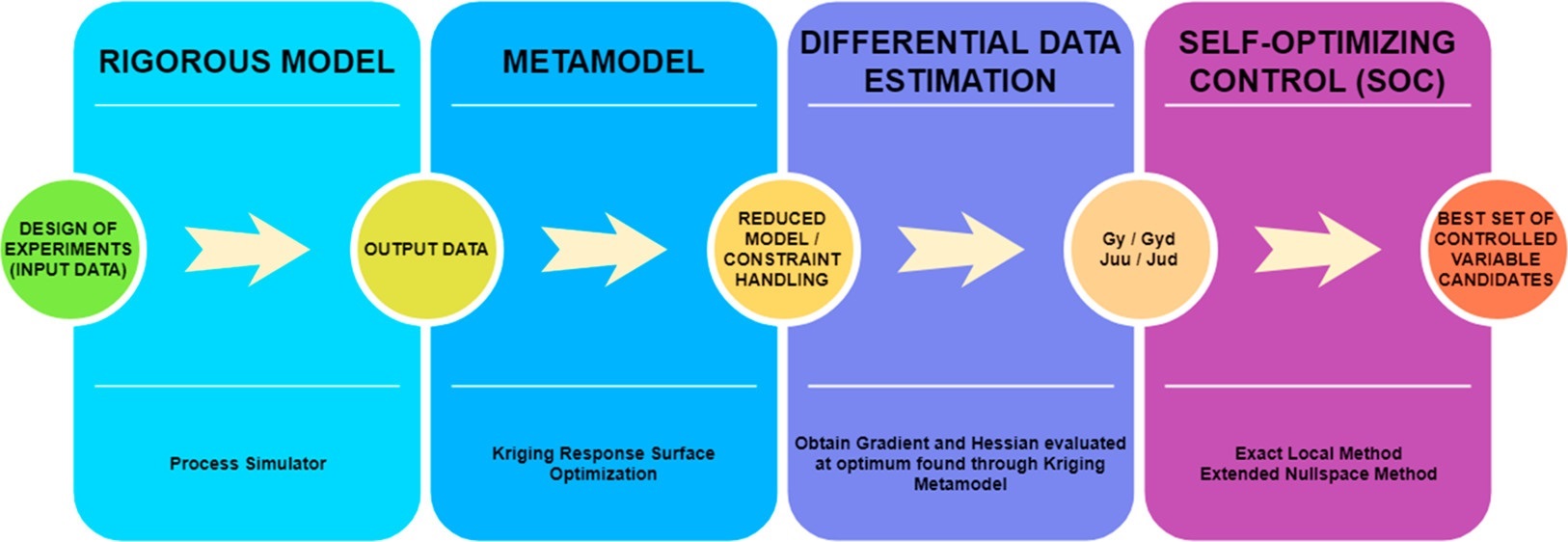 Metamodel-based numerical techniques for self-optimizing controlVictor MC Alves, Felipe S Lima, Sidinei K Silva, and Antonio CB AraujoIndustrial & Engineering Chemistry Research, 2018
Self-optimizing control technologies are a well-known study field of control structure design, having a robust mathematical background. With the aid of commercial process simulators and numerical packages, process modeling became an easier task. However, dealing with extremely large and complex systems still is a tedious task, and sometimes not feasible, even with these innovative tools. Surrogate models, also called metamodels, can be used to substitute partially or totally the original mathematical models for prediction and optimization purposes, reducing the complexity of evaluating large-scale and highly nonlinear processes. This work aims at applying recent self-optimizing control techniques to surface responses of processes using the Kriging method as a reduced model builder. A procedure to apply self-optimizing control to surrogate responses was described in detail, together with how the optimization can be done. Well-known case studies had their surface responses successfully built and analyzed to generate using the techniques cited, the optimal selection of controlled variables that minimizes the worst-case loss, and the same results were found when compared with the implementation in the original models from previous authors. The results indicate the effectiveness of the reduced models when applied to design self-optimizing control structures, simplifying the task.
@article{alves2018metamodel,
  title = {Metamodel-based numerical techniques for self-optimizing control},
  author = {Alves, Victor MC and Lima, Felipe S and Silva, Sidinei K and Araujo, Antonio CB},
  journal = {Industrial \& Engineering Chemistry Research},
  volume = {57},
  number = {49},
  pages = {16817--16840},
  year = {2018},
  publisher = {ACS Publications},
  doi = {10.1021/acs.iecr.8b04337}
}